The DeLara Prediction Engine
In the book "The Girl Behind The Light" I dreamt up an idea for an other-world type of computer known as a prediction engine. This would be based on an analogue music synthesiser of which I have several at home. I've been using them since the early 1970s so I could test my idea with the real thing and it proved to work very well so I added a chapter to the book featuring it.
See a real 1960s analogue computer below and also the passage from the book which describes "The DeLara Prediction Engine".
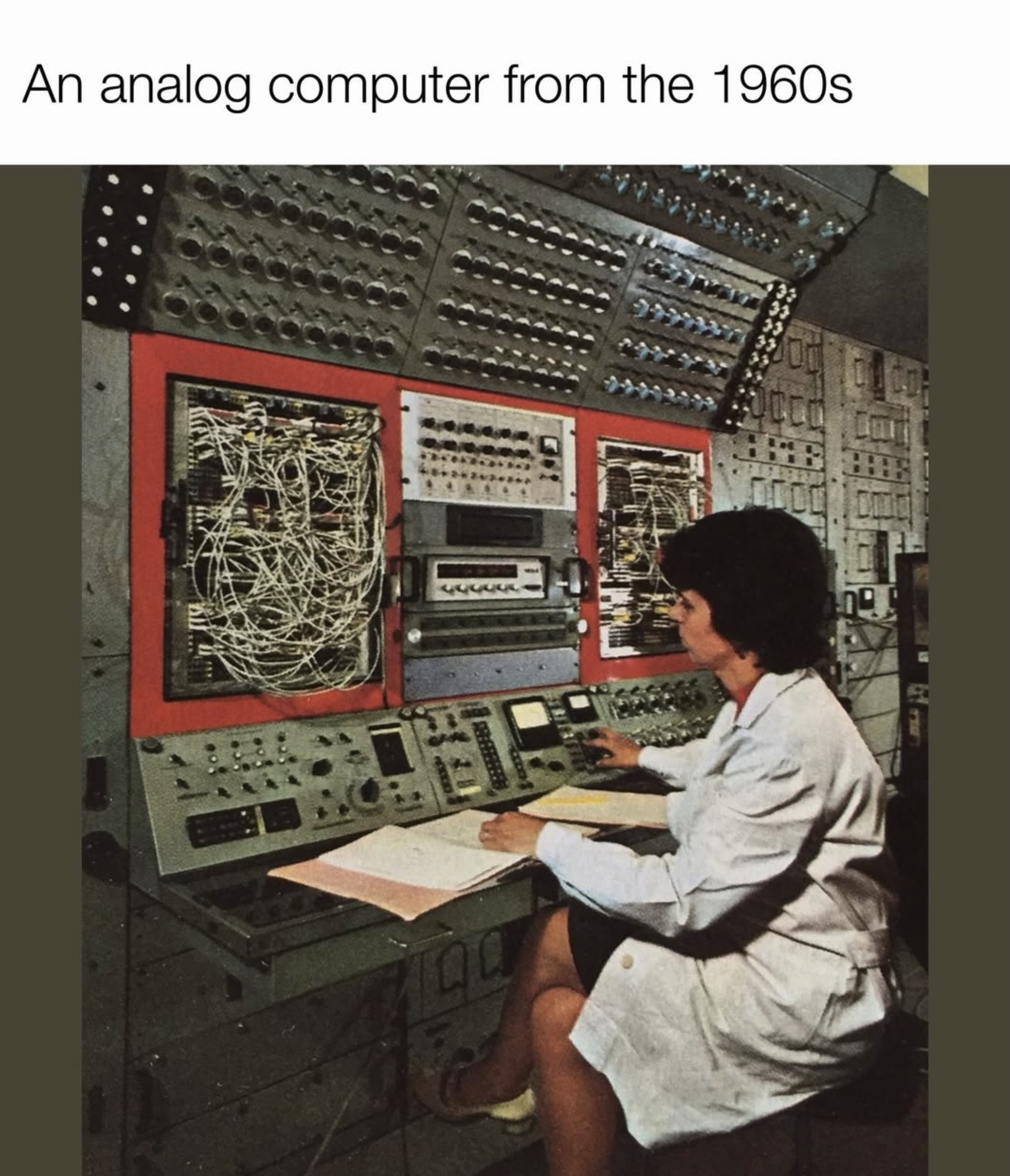
"With his curiosity aroused, he knelt down and peered underneath, hoping to find a dropped key but expecting to find nothing but the floor. It was dusty and dark but he could just make out a shape right at the back near the skirting board. He worked his hand underneath until he could feel it and carefully pulled it towards him. It was a heavy duty electrical plug with a fat, woven cable attached. It wasn’t like the funny little plugs on the vacuum cleaner and some of the lamps, they were all marked “40 Voltaire”. This plug handled much more power. -
- Above him there was a clunk, followed by a low-level electrical hum as the doors of the cabinet slowly swung open, revealing a mass of knobs and switches behind a sprawling mess of cables.
After dusting himself down, James stared in amazement at the sight before him. The inside of the wooden cabinet held several rows of black metal panels. Tiny lights were flashing on them, some at random, some in sequence. A plaque inside the door pronounced the machine to be a "Predictione engine".
He looked more carefully at the machine before him and recognised layout as being similar to the early Moog modular music synthesiser like the one he’d found on top of the piano in The Grange.
This was a field he understood and he examined everything once more in detail to verify that he was right. He found a switch marked “Chart” which, when flicked on, caused a loud clunk from a side table across the room as the top of it jumped and shook the ornaments. He cleared it and lifted the top to reveal a loaded roll of graph paper and several graph pens poised at the ready. The roll of graph paper was yellow with age but still serviceable and was marked out in voltages from minus, to plus twelve “Voltaire”.
One more look through the note book convinced him that he had found a kind of analogue computer where, instead of binary data, it used voltages to generate answers to anything the operator could dream up. The rows of modules in the cabinet generated or modified these voltages which could be used to represent elements of the problem being addressed such as time of day, temperature and many more subtle additions. The results were marked out by the pen on the graph paper.
Judging by the detail of the last settings in the book, Daniel DeLara had obviously been planning to run the machine for something important. James adjusted the initial settings for temperature, humidity and as many other factors as he could find, to those of the current day and time, checking carefully that they were as accurate as possible before attempting to run the machine. A small button on the sequencer shone red. He pressed it and a long row of tiny lamps started to chase from left to right, along the front panel. The dried out pens started to scratch away at the graph paper and James quickly pressed the stop button."